Sunday, August 12, 2018

Will Francis Be The Last Pope?

Dear Readers: I have to apologize for not posting comments or responding to those comments for the past week.  It was 100% my fault.  The comments received have been posted and I will respond to each comment shortly.  Again my apologies... 

History Channel aired an interesting two-hour documentary tonight that I participated in as a commentator about Saint Malachy O'Morgair (1094-1143).  Born in Armagh, Northern Ireland, he became the Archbishop in Armagh, and first met Bernard de Clairvaux at Clairvaux Abbey, where he stayed while in France during his pilgrimage from Ireland to the Holy Land.  So impressed with the asceticism and "perfection of the religious life" of the monks at Clairvaux under Bernard, they became close friends where Malachy expressed a desire to join the abbey as a monk.  Bernard advised him to return to Ireland to establish a monastery there. (Konemann, Page 256, 2006) In 1142, he established the abbey of Mellifont in the Boyne Valley roughly a 45-minute drive north from Belfast.

What most people don't know is on the granges, or lands, of the Cistercian monks at Mellifont were three megalithic ritual temples archaeologists today call "passage tombs" for the dead.  The most famous of these is a UNESCO World Heritage Site called Newgrange.  In fact, these incredible structures believed to be over 5,000 years old, were ancient observatories the monks actually excavated in the twelfth century.  Having visited the site in 2012, it is quite clear Newgrange, which has a long stone-lined tunnel with three niches at the center, captures the light of the rising sun to the southeast on the Winter Solstice.  What few people know is the alignment of the tunnel and the deepest most niche are most accurately aligned to the planet Venus at sunrise on the shortest day of the year.  This fact is further evidenced by the eight "X's" carved in base relief into the slab of stone directly above the entrance that allows the light of Venus, and the sun, to enter the tunnel on the solstice.  Eight is the number of Earth years it takes for the planet Venus to make the five-pointed star when viewed from Earth astronomically.  It is a deeply sacred number to the Cistercians and many other cultures who embrace the "Hooked X" ideology of Monotheistic Dualism.

You might be asking what does all this have to do with the Malachy Prophecy?  The simple answer is the Cistercians, and Saint Malachy, were deeply versed in astronomy/astrology and understood the concepts associated with Precession of the Equinoxes.  Essentially astronomer priests, they received ancient knowledge passed on through initiation and ritual about the 26,000 year long cycle of the twelve primary constellations of the zodiac when viewed from Earth.  Possessing this knowledge was how Malachy knew something profound was to occur in 2012, the same year cultures like the Mayans, who also understood and venerated astronomical precession, knew the old "Great Year" would end and the new "Great Year" would begin.  It's quite possible, if Malachy in fact made the 2012 predictions, the presence of the ancient megalithic observatories on the granges at Mellifont may have had something to do with that knowledge and the prophecies.


Stained glass image of Saint Malachy at the Cathedral of the Immaculate Conception on Temple Street in Sligo, Ireland. Photo by Andreas F. Borchert, CC BY-SA 4.0, https://commons.wikimedia.org/w/index.php?curid=45864216  


The octagonal shaped lavatorium that sits on eight columns with Romanesque arches survives somewhat intact at the Cistercian monastery of Mellifont that was founded by Saint Malachy in 1142.  


Author Alan Butler and I stand in front of the over 5,000 year-old megalithic structure called Newgrange in the Boyne Valley of Ireland.  This structure has a diameter of over 300 feet and is one of three such ancient observatories that capture the light of the setting sun, and the planet Venus, on the winter solstice. 


Outside the entrance to the stone-lined tunnel that leads to three chambers at the center of the  structure are large curbstones with ornate carvings of spirals and other symbols.


Above the opening that is the entrance into the tunnel is a large slab of stone with eight "Xs" carved in base relief.  The primary winter solstice alignment is for the planet Venus which the eight carved "Xs" appear to be consistent with.

Sunday, March 18, 2018

Does a 1939 aerial photograph prove the Newport Tower is a Templar Church?


This 1939 aerial photograph of Touro Park shows the clearly visible, round nave of the Newport  Tower, and what appears to be the rectangular shape of a chancel running east-west on the east side.  More info about this photos can be found at the following link: https://www.facebook.com/pg/Phippsburg-History-Center-114338978642314/photos/?tab=album&album_id=1600659460010251  


Researcher Patrick Shekleton, noticed what appears to be a rectangular imprint in the grass on the east side of the Newport Tower.


This schematic of the Temple Church, in London, England, shows the round nave and rectangular chancel facing east that is eerily similar to what appears in the 1939 aerial photograph.


In a Gothic cathedral, such as this schematic of Reims Cathedral in France, the nave of the church is rectangular in shape and faces to the west.


This schematic of Cambridge Round Church in Cambridge, England, show an identical layout the Newport Tower likely had when first constructed in the early 1400's, minus the north and south aisles.  Image can be found at the following link: http://www.victorianweb.org/victorian/art/architecture/salvin/1d.jpg


Cambridge Round Church was built by the Knights Templar, circa 1130, and exhibits the exact same design and architecture as the Newport Tower.  Several factual pieces of evidence are consistent with the Newport Tower having a one-story ambulatory like the ones at both Cambridge and Temple Churches in England, in addition to several others such as the Charola in the round nave in the Templar church in Tomar, Portugal.  


Inside the church at the Convent of Christ Castle in Tomor, Portugal, is the beautifully illuminated, two-story octagonal tower that sits on eight heavy columns called the Charola.  It was built by the Knights Templar in 1161, and its design also mirrors the Newport Tower. 


The areas in red were built by the Templars in the 1160's and include the two-story octagonal Charola that served as an architectural archetype for the Newport Tower in Newport, Rhode Island.    


All eight stone columns in the Newport Tower have a slate slabs at the base, and at the top that serves a structural function as a capstone ledge to support the wooden trusses of the roof for the first-story ambulatory.


Clear evidence of what was a wooden, first-story ambulatory can seen with the capstone ledges atop all eight columns, at approximately eight feet above grade (yellow arrows), and the where the roof met the exterior tower wall roughly four feet above the ledges (red arrows).


This test pit was dug during the salvage archaeological dig at the Newport Tower, reportedly in the area of the rectangular shape seen in the 1939 aerial photo.  Could the layer of stones, which do not appear to be a natural glacial geological feature, be remnants of the foundation for the rectangular structure?

Recently, friend and fellow researcher, Patrick Shekleton, forwarded a 1939 aerial photograph of Touro Park and wrote that he noticed what looked like a rectangular shape image running east-west on the east side.  I didn't have to look too hard and sure enough, there did appear to be a rectangular shape in the grass apparently reflecting the imprint of the footings of structure that was once attached to the round tower.  Pat and I discussed the image and the his posting of the discovery on the Phippsburg, website.  While it is certainly possible the rectangle could be from a structure built long after the Tower was constructed, its close proximity suggests it's connected.

The image of the test pit dug during the salvage archaeological dig conducted by Chronognostic Research Foundation shows a soil horizon profile within excavation unit located to the east of the tower.  The man-made glacial stone layer was identified as a portion of a potential structure foundation: "Under these dumped layers is a layer of native stones.  The stones tell us that there may have been a structure east of the tower.  This is important because our research has shown that there were no structures around the Tower since the town's founding in 1639.  (http://www.chronognostic.org/over_touro_park.html)

Let's assume for a minute there was a structure on the east side of the tower.  If so, the layout of the rectangular structure follows the exact footprint of a church constructed ONLY by the medieval Knights Templar.  The diagrams and photos above of Temple Church and Cambridge Round Church in England, and the Church at the Convent of Christ Castle in Tomar, Portugal, are the same as what is gradually unfolding at the Newport Tower.  Based on the evidence already present at the Newport Tower, such as the capstone ledges at the top of the eight columns as published in my book, "The Hooked X: Key to the Secret History of North America" (see page 185), and the remnants of two wooden posts that supported the roof that was discovered by archaeologists in a 2008 salvage excavation, each sixteen feet from from stone columns (see page 186), there was indeed an ambulatory, most likely constructed of wood, that encircled the still standing, two-story structure.  Based on the 1939 aerial photograph discovered by Patrick Shekleton, there appears to have also been a rectangular shaped chancel that connected perfectly with the long ago disintegrated wooden ambulatory that encircled the enigmatic circular stone and mortar structure.  More work certainly needs to be done, but when this new evidence is combined with the architectural design, the Masonic notched keystone symbolism, the long-range alignment to the Kensington Rune Stone (see pages 211-228), and the solar illumination of the egg-shaped keystone on the winter solstice, there can no longer be any doubt the Newport Tower was constructed by the Knights Templar sometime around the year 1400.     


Friday, February 9, 2018

A New Medieval Runic Inscription in North America?

Just this week, I had the privilege to examine yet another, previously unknown runic inscription here in North America.  It is a very short inscription and only had a short time to spend with it, but what I saw during my visit was very interesting indeed!  The short, three-rune inscription was carved into a large glacial erratic boulder of granite gneiss that had a very flat top surface providing a perfect substrate to carve on.  These runes are the largest I've ever seen at approximately six inches in height.  The three runes are well carved and easily read as a bilateral "n" (Meaning the angled bar in the center appears equally on both sides of the vertical line called a "stave."), an open looped "r" (Meaning the lower line of the upper loop angling back to the middle does not touch the vertical stave), and a so-called "thorn" rune.  One other interesting aspect of the "r" rune is the line angling to the lower right forming the top loop does extend and meet the top of the vertical stave.  This is the first time I have ever seen an "r" rune like this after reviewing hundreds of Scandinavian and North American runic inscriptions. 

Putting all the runes together, the inscription appears to spell "Nrth."  However, I will let the runological experts make the call on this one as it is not appropriate for me to portray myself as an expert in this field.  I know enough about runes to be dangerous, but I want to make it clear I am not a qualified expert.  What I am an expert on is commenting on how the runes were carved into rock as hard as granite, which was clearly using metal tools, as I have carved and painted my own rune stone into a granite gneiss boulder myself.

As I carefully examined the carvings, I was shocked to see something I never expected.  At the end of the lower right leg of the "r" rune was an intentionally made, large hole or dot, exactly like the one on line one, in the word "göter", on the Kensington Rune Stone!  This particular anomaly in the KRS inscription was interpreted by Richard Nielsen and myself, to be part of what we called a "Grail Code."  This was because the first four runes that were singled out by the carver on the KRS, with either dots or short strokes, in sequence, spelled, "GRAL" or "Grail."  Whether there is any connection to the KRS, or the Templars/Cistercians who created it, is unknown.

Lastly, I have to say that the carvings did look weathered, but it was a very brief look and it could, in fact, be recently made.  I am reticent to offer any age for the inscription until I am able to spend more time studying it to see if there is a scientific way to determine a relative age.  This is also the reason I am not going to reveal its location to ensure the inscription is not altered in any way by potential vandalism.  Having said that, I would entertain inquires from legitimate scholars that might be interested in seeing the inscription as more work definitely needs to be done.


On February 6, 2018, I had the opportunity to examine a brand new, three-character, runic inscription carved into a large glacial boulder of granite gneiss. 


The three runes that make up the inscription are a bilateral "n", an open looped "r", and a very well carved "thorn" rune, which typically when found at the end of a word typically represents the "th" sound.


This picture was taken at an angle to the inscription that highlights a deep hole the carver made at the end of the lower right leg of the "r" rune.  This feature is exactly the same as the dot the carver made in the same location in the first "r" rune in the word "göter", on line one, in the Kensington Rune Stone inscription. 


There is a clear and distinct intentionally made dot at the end of the lower right leg of the "r" rune in the word "göter", on line one of the Kensington Rune Stone inscription.


A closer view of the man-made dot at the end of the lower right leg of the "r" rune, in the word "göter", on line one of the Kensington Rune Stone inscription.


In May of 2005, it took 40 hours to carve this rune stone commemorating the book I co-authored with Richard Nielsen entitled, "The Kensington Rune Stone: Compelling New Evidence."  

The following photos of the most recent renditions of the ever-evolving translation of the Kensington Rune Stone are posted here in response to a troll's attempt to undermine the legitimacy of numerous intentional punch marks and short strokes added to numerous runes AFTER the inscription was carved.  The troll attempted to post a hastily written, angry rebuttal letter by a scholar who tried to use his perceived authority to play fast and loose with man-made features added by the carver.  This letter came on the heels of a paper I wrote on my microscopic 3D imaging work that documented these features whose impact on the authenticity of the KRS was vitally important.  You can read my paper at the following link:  http://kensingtonrunestone.us/html/rune_stone_3-d_study.html 

What is important to notice here is both Henrik Williams and Richard Nielsen peer-reviewed and endorsed the Dotted R and several of the other dots and short lines as intentional and meaningful aspects of the inscription Nielsen and I published in our 2006 book, The Kensington Rune Stone: Compelling New Evidence.  In some cases they served linguistic purposes, in others they were part of various codes, all reviewed and accepted by both scholars.  However, in 2007, the pair suddenly reversed course and decided the modifications were not the important features we had already published.  The new interpretation was they were "guide marks", "decorations", or in the case of the vitally important Dotted R on line 6, was the result of a "dropped tool mark."  I'm still amazed at how the clumsy carver was skilled enough to accidentally drop his chisel so the point just magically hit the perfect spot to create a dot that proves the authenticity of the KRS all by itself.  What are the odds...?    

The point of posting the two translations is to show how the two scholars played fast and loose with the physical features on the inscription.  In 2010, in the word "death" on line 8, they published two dots in the "thorn" runes and I'm convinced the second dotted "thorn" was going to be the big discovery they planned to make.  Unfortunately, Nielsen was denied access and Williams, reportedly, threw a fit.  Later that evening during his lecture at the Alexandria Community College, we all heard a clearly agitated Williams complain about their treatment at the museum.  I suspect because their plans to discover the Dotted "thorn" together were foiled by the museum, they apparently decided to make the dots in both the Dotted R, and the Dotted "thorn", go away.   This is evidenced by the 2014 translation as seen below.  

The problem with all of this is here we have two scholars, apparently, trying to play with physical aspects of the inscription to serve an agenda.  They certainly have the right to change their mind about interpretations of what these man-made features represent, as long as they provide proper evidence to justify and support the new opinions.  However, they cannot decide what are man-made physical features on the stone and what are not.  It is inappropriate and unethical.  

Sadly, Richard Nielsen passed away in July of 2016, and can no longer comment on the information I have presented.  However, I invite Professor Williams to defend his and Nielsen's actions by responding to my comments on this blog with facts I may not aware of, but I would not hold my breath he will do.  In the end, this type of behavior by scholars hurts not just the Kensington Rune Stone, but all of us who simply want to know the truth.     


This translation of the Kensington Rune Stone inscription was published by Henrik Williams and Richard Nielsen in 2010.


A close-up view of line eight shows a two dotted "thorn" runes in the word "death."


This translation of the Kensington Rune Stone inscription was published by Henrik Williams and Richard Nielsen in 2014.


A close-up view of line eight shows the once present dotted "thorn" runes in the word "death" have been removed.


Thursday, January 4, 2018

Kensington Rune Stone Visitors Center is Officially Open


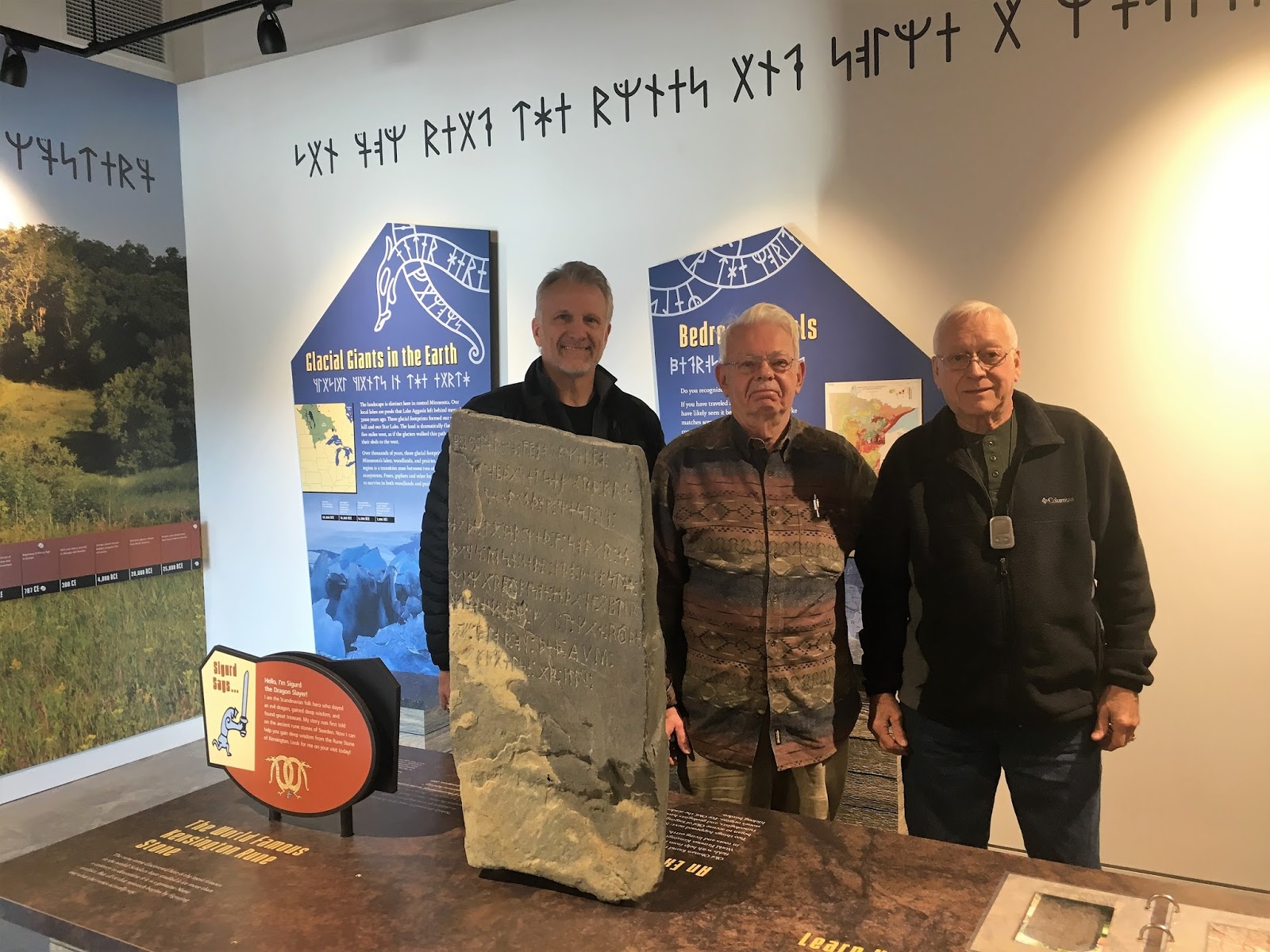
The Grand Opening of the Kensington Rune Stone Visitors Center at the Ohman Farm, in Kensington, Minnesota, was held on Wednesday, January 3, 2018.  It was minus 1 degree on clear and sunny day and I made the two-hour trip up from the Twin Cities with John Freeburg, and our driver, Darwin Ohman, grandson of the discoverer of the Kensington Rune Stone.  Darwin and I have made this drive to the farmstead many times over the years for many lectures, various meetings and of course to perform different areas of research.  Today's visit was to celebrate a milestone in the history of the artifact by finally having a modern interpretive and visitor's center where the artifact was first discovered in the fall of 1898.  In my view, the Kensington Rune Stone is the single most important historical artifact ever discovered on this continent that for all intents and purposes was the beginning of the founding of what would become the Untied States of America. 


It was a cold (minus 1 degree) and clear day when the Grand Opening of the Kensington Rune Stone Visitors Center at the Ohman Farm was held on January 3, 2018.

The three of us arrived early as the Director of Douglas County Parks who was responsible for the project, Brad Bonk, greeted us at the door with a big smile.  Darwin and I had met with Brad multiple times over the past two years offering information about the history of the family, and research on the artifact, as the project moved forward.  The building of steel framing, concrete and wood was simple and elegant with the east room dedicated to the story of the stone, the inscription, and runes in general.  One thing that especially pleased me was to see thee Hooked X in the interpretive displays.  Some people wanted the Hooked X and some of the other  controversial symbols eliminated from the displays, but fortunately, Brad and other consultants chose to keep the runic displays true to the symbols found on the artifact.


Inside the interpretive display room myself, John Freeburg, and Darwin Ohman stand behind a replica of the Kensington Rune stone. 

Shortly before 2:00 p.m., a steady stream of local politicians and media trickled in and at 2: p.m. sharp, the brief ribbon-cutting ceremony was underway.  Within less than 10 minutes, the bright red ribbon was cut and everyone was back inside.  After downing a hot cup of coffee and an hour or so of glad-handing, it was time to make the two-hour trek back home.  On the ride back, the three of us talked about not just how impressed we were with the facility, but how it was still only one positive step in a much longer journey.  For me, the highlight of the entire day was seeing the smile on Darwin Ohman's face knowing that exoneration of his grandfather's reputation was inching closer to universal acceptance. 


Director of Douglas County Parks Brad Bonk, and other dignitaries, prepare to cut the red ribbon at the ceremony in front of the new Visitors Center.


Brad Bond and Andrea Dwyer with the Alexandria Lakes Area Chamber of Commerce stand with ribbon cutting scissors in front of the new Visitors Center at the Ohman Farm, in Kensington, Minnesota. 

Tuesday, November 21, 2017

Proof Positive the Kensington Rune Stone is Medieval

While researching deeper into the Ritual Code within the Kensington Rune Stone inscription I discovered in early 2016, it led to another incredible discovery that by itself proves the medieval origin of the artifact.  Briefly, I discovered the first four symbolic numbers of 8, 22, 2 and 1, as they occur in sequence add up to 32, then 33, which equals the system of degrees within Scottish Rite Freemasonry.  These numbers are directly related to the Hebrew mysticism of the Kabbalah that traces the same numbering system to the number of bones and nerves in the spinal cord (32) with the skull, and brain within it, totaling 33.

The remaining numbers of 1, 10, 10, 14, relate to the Ten Commandments, the Enochian Legends, and the Isis/Osiris mysteries and the allegorical stories of the annual cycle of life on earth that every culture on the planet experiences.  In short, the Kensington inscription is largely allegorical with certain factual information peppered in for the initiated few to decipher.  The inscription was carved by a deeply initiated medieval monk who understood these alchemical teachings creating a brilliant message that included codes (Dating and Grail Codes) and important symbolism I have already published in my books.

What the initiated Cistercian monk also understood was the ancient and very sacred measuring system used by cultures dating back over 10,000 years that was calculated using the planet Venus: the Megalithic Yard.  British researcher, Alan Butler, wrote about his rediscovery of the megalithic yard in his groundbreaking book, City of the Goddess: Washington D.C.  Alan discovered that not only did ancient cultures build the world famous megalithic structures like Stonehenge in England, Newgrange in Ireland, the Great Pyramids at Giza in Egypt and other sites around the world, but the Founding Fathers of the United States built our capitol city in Washington D.C. using the same megalithic system.  

I have argued for nearly two decades that Freemasonry evolved from the medieval Knights Templar and most people know many of our Founding Fathers were Freemasons.  I maintain knowledge of the megalithic yard system of measurement was passed on to people like Thomas Jefferson, through Freemasonry, along with many other secrets directly from the Templars.  From there I used logic to try and determine if there was any other evidence on the Kensington Stone that might shed new light on who created it.  Sure enough, yet another connection to the Templars, and the initiated Cistercian monks who traveled with them, was there.

The megalithic yard is 2.72 feet in length.  If we multiple that length by 12 inches we get a total of 32.64 inches.  I asked Janet to take a length of string she had cut to that length and measure the length of the cast we own of the Kensington Stone, and it was about an inch short.  However, when she measured it diagonally across the face of the stone it was exactly one megalithic yard in length.  Keep in mind the carver was working with an irregular shaped slab of a glacial erratic, yet was still able to skillfully split the slab down to nearly the exact sacred dimensions he wanted.  As I have argued before, the primary purpose of the Kensington Rune Stone was to be a Templar land claim to establish a sanctuary where they could practice freedom of religion and freedom from the tyranny and oppression of the monarchs of Europe.  The Rune Stone was beginning of the founding of the United States and to ensure its protection the carver appears to have acknowledged Deity by using the sacred measuring system derived from the planet Venus; who to him and his Cistercian/Templar brethren was the physical manifestation of the Goddess in the heavens.  

   
Stonehenge in England is arguably the most famous megalithic structure in the world built using the megalithic yard over 5,000 years ago.


Newgrange in Ireland also dates back over 5,000 years and incorporates the megalithic measuring system.


The Great Pyramids of Egypt are believed to date back over 10,000 years and incorporate the megalithic yard.

The temple pyramid at Chichen Itza in Mexico had the megalithic yard used in its construction over 1,000 years ago.


When measured down the split side of the Kensington Rune Stone it measures just over an inch longer than a megalithic yard of 2.72 feet.


However, when measured diagonally across the face of the artifact that distance is exactly one megalithic yard, or 32.64 inches in length.  


The Thomson Formation of metagraywacke weathers into flat tabular slabs as can be seen along the banks of the St. Louis River, in Jay Cook State Park, a few miles south of Duluth, Minnesota.  The Kensington Rune Stone was carved into a large tabular slab of metagrawacke plucked by continental ice and carried to somewhere near the Ohman Farm roughly 10,000 years ago.


This diagram shows the Newport Tower conforms to the Megalithic Yard measuring system in its construction.  Since the Tower and the Kensington Rune Stone are connected through long-range alignments of the egg and notched keystones, it should be no surprise both artifacts were constructed by the medieval Cistercians and Knights Templar using the same ancient, and sacred, measuring system.  


This measuring stick with runic carvings was found in Norway and has a curious mixture of runic symbols including a reasonably close rendition of the Hooked X (Top left in upper photo).  The stick, and presumably the runic carvings, are believed to date to 1888 or before. 


On the back side of the stick is the runic alphabet that fairly closely matches the KRS alphabet.  Below is a Masonic box code that matches the runes and letters above. 

Sunday, October 29, 2017

Did Juan Ponce de Leon Carve the Overton Stone?

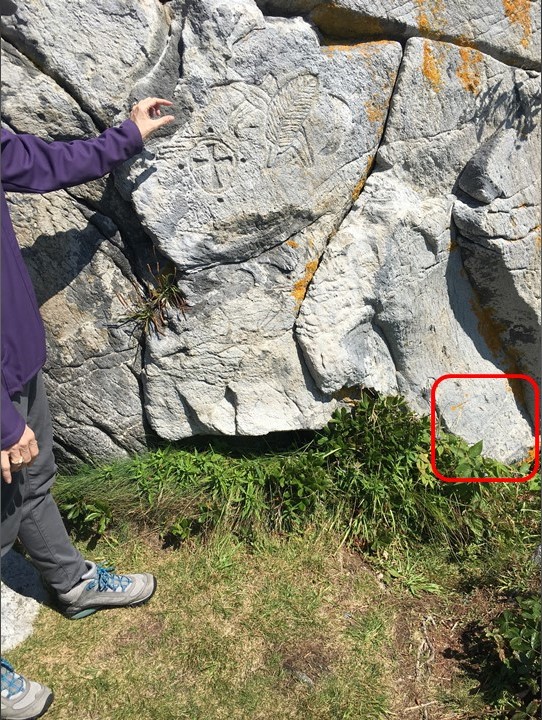
While researching early explorers to North America I stumbled upon something that jogged my memory.  On a trip to Nova Scotia this past August, Janet and I examined an amazing carving on the extreme western coastline called the Overton Stone (See blog post dated September 3, 2017).  The primary carvings are of a Christian style cross within a circle together with what appears to be a feather with two crossed leaves of tobacco and a crescent moon or the crescent of the planet Venus when viewed from earth.  But that is not the full extent of the carvings on the bedrock outcropping.  Just above ground level, roughly four feet to the lower right of the main group of carvings, is another interesting cluster of carvings.


A second cluster of carvings is found roughly four feet to the lower right of the main group (red boxed area) of carvings Janet Wolter is pointing to.


The second cluster includes two carvings with loops and curved lines at the top and the apparent numbers '06' and '07' below. 


A closer view of the carvings on top show what appears to be an "S" lying sideways to the right and a pair of "fish" symbols carved as a single continuous line on the left.

The second cluster of carvings includes two symbols with curved lines above what appears to be the numbers '06' and '07' close to the ground.  What caught my attention was the strange symbol with twin loops carved with a single continuous line.  While surfing the web looking for Hooked X symbols in the signatures of famous explorers, one in particular jumped out.  Juan Ponce de Leon (1474-1521) was a Spanish explorer known to have visited the shores of what is now known as Florida while searching for the "Fountain of Youth."   https://en.wikipedia.org/wiki/Juan_Ponce_de_Leon 

While there is no known record of the famous explorer ever sailing as far north as Nova Scotia, but that doesn't mean he could not have.  The symbol circled in the image of Juan Ponce de Leon's signature below is the reason I bring up the possibility.  The "de" in de Leon's signature is strikingly familiar to the double looped carving on the Overton Stone.  The only meaningful difference between the two symbols is the bottom end of the carved line on the far right bends to the left instead of the right.     


The "de" in the signature of Juan Ponce de Leon (circled in red) looks strikingly similar to the double looped carving on the Overton Stone.

The most likely timeline for what could have been a secret voyage to Nova Scotia are between 1493, when he traveled to the Caribbean as a crew member on Columbus' second voyage, and 1503.  The second would have been sometime after 1513.  While many of his expeditions are well documented with no mention of his traveling as far north as Nova Scotia, there are significant gaps in the records that could have made such a trip possible.  The other problem with Juan Ponce de Leon, who was known to have been very violent to the natives in the Caribbean, and the Overton Stone, is the carvings suggest some kind of agreement or strategic alliance with the local indigenous people.  This would be at odds with his known behavior.  However, if he had been in Nova Scotia with a small contingent so far from home, his attitude toward the natives may have been different.  

Regardless, the striking similarity of the two symbols and a possible connection to the famous Spanish explorer begs the question to be asked.  What do you think?       


The Spanish Explorer Juan Ponce de Leon is credited with the discovery of what is now known as Florida during his search for the "Fountain of Youth."


Sunday, September 3, 2017

A Preliminary Investigation into the Geology of the Overton Stone

On a perfect sunny day on August 31, 2017, my wife and I along with three friends hiked along the rocky shoreline of extreme southwestern Nova Scotia, Canada, to see, potentially, one of the most exciting petroglyphs in North America.  As we approached the two, car-sized boulders sitting on a slight rise roughly three-hundred feet from the ocean at low tide, the carvings quickly came into view. 

The carvings are on the south-facing surface of the larger boulder roughly four feet off the ground.  What stood out most prominently was the approximately six-inch tall Templar style cross encircled with an egg-shaped line that had four dots at the cardinal points at the flared ends of the cross.  The lower arm of the cross is longer than the other three resembling a Christian style cross some have interpreted to be connected to the Portuguese Templars.   Immediately left of the cross is what some say is a leaf, but to me it looks like a feather carved in detail.  Underneath the feather are what appears to be crossed tobacco leaves in the form of an “X.”  Immediately to the right of these is a carving of a crescent moon or possibly Venus.


Janet Wolter points the Overton Stone carvings of a Templar Cross, crossed tobacco leaves, a large feather and a crescent moon. (Courtesy of Patrick Shekleton)

My goals for the investigation were to document the rock type which is a strongly foliated mica schist, obtain a rock sample from the back side of the boulder for laboratory analysis of the mineralogy to try and understand aspects of the weathering, examine the depths and weathering aspects of the carvings, and to assess the site for possible archaeological assessment and possible dating of the carvings.  Fortunately, I was successful in all getting everything I hoped to accomplish on this trip done.  I’ll provide additional comments about the laboratory analysis of the rock and the archaeological work as results become available.

Of course, the significance of these carvings to my own and others’ research is huge.  If several centuries old they represent what was likely the consummation of a strategic alliance between a group of Knights Templar from Europe and the local indigenous people; the Mi’kmaq.  It would provide powerful new evidence that not only that pre-Columbian Templars visited these shores, but they had positive relations with Native Americas.  I have argued for years this allegiance was due in large part to their shared ideological views that included above all else a deep reverence of the Goddess they also called the, “Holy Mother.”  These carvings go a long way to proving this thesis was indeed true.  Stay tuned as we learn about these amazing carvings.